The Monkey in the Middle: Ripping 400 DVDs Without Losing My Mind
For decades I carried around more than 400 DVDs, always telling myself I’d rip them into my home media streaming system. The sheer volume made the task impossible to pick up — every approach started with a weekend of heroic encoding that never arrived. The breakthrough was accepting a humble truth: the machine can’t load the tray, but I can. So I turned myself into a human in the middle — a monkey to load a DVD tray — and automated everything else.
The result is dvd-backup-pipeline: lawful personal-backup DVD automation that evolved from a simple “watch the drive bay and rip what it finds” script into a two-worker pipeline with metadata lookup and a decoupled transcode queue.
The evolution
Stage one: watch and rip. The first version monitored the drive bay, ripped what it found, encoded, filed. The fatal flaw was coupling: the DVD drive sat hostage for the whole encode (an hour+ per disc), so throughput was bounded by patience, and the tray spent most of its time empty and waiting.
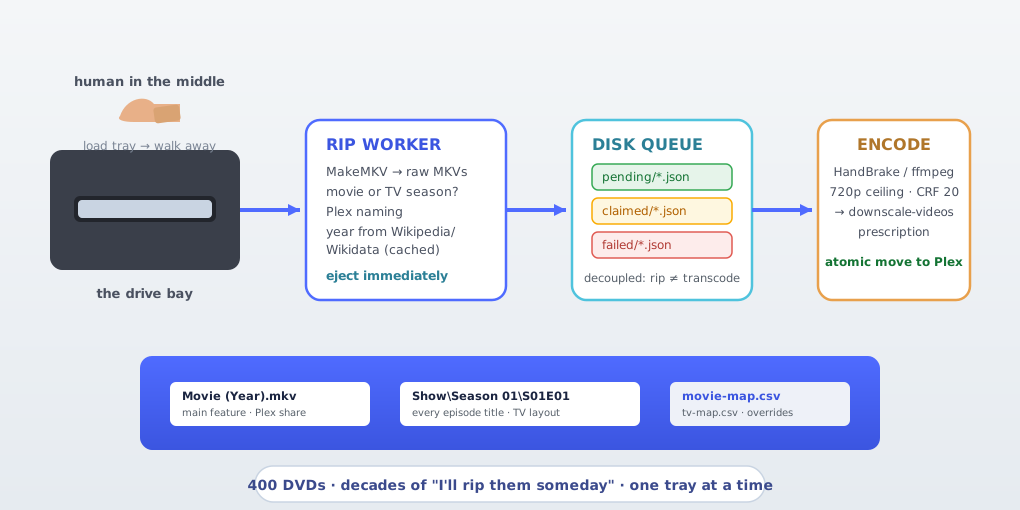
Stage two: decouple rip from transcode. The core insight of the pipeline: ripping and encoding are separate workers connected by a disk-backed queue. The rip worker identifies the disc, classifies it as a movie or TV season, resolves Plex metadata, rips every selected title to raw MKVs with MakeMKV, publishes encode items to the queue — and ejects the disc immediately. The encode worker (auto-started in a second console) claims the oldest queued item and encodes in the background while I’m already loading the next disc. My job is reduced to tray-loading; the queue absorbs the speed mismatch between a disc drive and an encoder.
Stage three: metadata without an API key. Classification produces Plex-perfect names — Movie (Year).mkv for a movie’s longest main feature; Show\Season 01\Show - S01E01 - Episode Title.mkv for a TV season (episodic labels or several similar runtimes tip it off; multi-disc seasons get -Season/-StartEpisode overrides). Missing years are filled from Wikipedia/Wikidata lookups — no API key needed — cached in year-cache.json, with optional movie-map.csv/tv-map.csv overrides for the discs that need human truth.
The engineering details
- Two runtimes, one baseline. The drive-facing watcher is PowerShell + HandBrakeCLI (Windows, where the drive lives); the cross-platform baseline is Python + ffmpeg (
bin/transcode.py— the single source of truth for the streaming profile). The repo’s docs compare them setting by setting: CRF 20 + bitrate caps vs. two-pass ABR sized to a 1.4 GB movie / 450 MB episode target, 720p ceiling with no upscaling, detelecine, interlaced-only deinterlacing, first-audio-track AAC, subtitles copied, metadata and chapters preserved. - A queue you can operate with your hands. Queue items are JSON files in
pending/,claimed/,failed/. A failure parks the raws inqueue\failedfor manual retry (move the JSON back to pending; delete both to abandon). No database, no daemon — you can fix the pipeline with a file explorer. - Standardization by composition. Encoding inherits the prescription from my downscale-videos project —
bin/_downscale.pyand a directory watcher lean on that tool’s decide-then-act logic, so anything entering the library conforms to the same household streaming standard. - The remaining bin tools round out the library:
scrub-titles(backfill missing years with a dry-run preview),combine,conform(scan a directory, transcode anything off-baseline, replace only after a successful encode), andsync.
What it taught me
The bottleneck of a 400-disc archive was never encoding — it was attention. Decoupling stages so the expensive resource (me) only does the one thing machines can’t (load the tray) converted a dreaded weekend project into a background behavior: a disc or two in the evening, the queue drains overnight, the shelf grows. The other lesson is that queues beat pipelines for physical-world work — eject-on-rip means the drive’s duty cycle is mine to control, and failed/ means errors are a parking lot, not a crash. Somewhere between stage one and stage three, “I should really rip those DVDs” became a system that finishes the thought for me.