Atlas: The Homelab Cluster Where Everything Else Gets Deployed
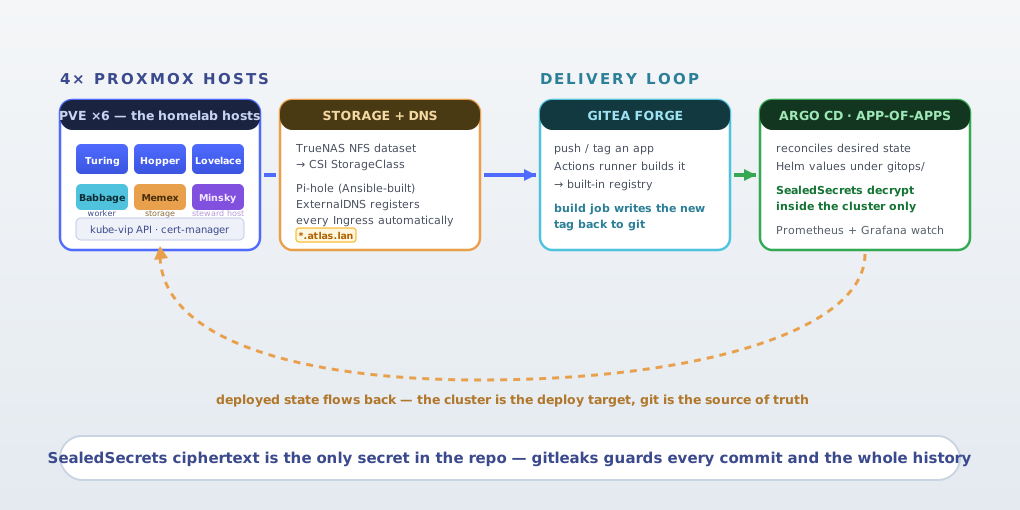
Every experiment on this blog eventually needs somewhere to run. Atlas is that somewhere — my homelab hobby cluster, the substrate the 211 Lab builds on: a four-host Proxmox VE cluster carrying a highly available K3s control plane, operated with the same GitOps discipline I’d demand in an enterprise environment.
Named in homage
I’ve been fortunate enough to be around computers for nearly 30 years now, starting as a young child, and between my gaming computer and this cluster I’ve always felt myself connected to computer science. So every device I keep is named in homage to somebody notable from its history — the naming is written into the 211 Lab organization profile like a little family tree:
- Atlas — the cluster itself. Not a person, but the 1960s British supercomputer from the University of Manchester, Ferranti, and Plessey — among the first machines with virtual memory and real multitasking support, and deeply influential in early OS design. A name for the machine everything else runs on.
- Titan — my gaming workstation, named for the Oak Ridge National Laboratory Cray supercomputer (2012–2019) that was among the first to pair CPUs and GPUs at scale. It earned its name twice over: it’s the machine whose GPU (the RTX 3090) powers my local-model research.
- Turing (control plane) — Alan Turing, the father of theoretical computer science: the Turing machine, the concept of the algorithm, the Enigma break.
- Hopper (control plane) — Grace Hopper, the compiler pioneer: high-level programming, COBOL, and the popularized art of “debugging.”
- Lovelace (control plane) — Ada Lovelace, who wrote the first algorithm intended to be executed by a machine — and saw that machines could go beyond arithmetic.
- Babbage (the worker) — Charles Babbage, who designed the Difference Engine and proposed the Analytical Engine.
There’s an unintentional joke in the topology I only noticed after the fact: the three hosts carrying the control plane — the nodes that deliberate and keep state — are the theorists and programmers (Turing, Hopper, Lovelace), while Babbage, the man who actually built machines, carries the worker doing the physical execution. The homelab reenacted the Analytical Engine’s division of labor without anyone planning it.
Two more names sit beside the four K3s hosts in the compute view, doing different kinds of work:
- Memex — named for Vannevar Bush’s visionary 1945 “memory extender,” the hypothetical device where a person stores all their books and records, navigable by association — the ancestor of hypertext. The homage fits exactly: Memex is the lab’s storage backend, the persistence layer the cluster writes everything to. It runs standalone by design — deliberately removed from the Proxmox cluster so a critical storage host never waits on quorum to bring its services up.
- Minsky — named for Marvin Minsky, the AI pioneer and MIT professor whose work on neural nets, symbolic reasoning, and multi-agent societies of mind planted the field I get to work in decades later. Fittingly for the name, Minsky is the physical host of the agentic steward — an autonomous agent that supports my home network in various ways, with its own project planned for a future post.
The shape of the cluster
Four physical Proxmox hosts carry the K3s VMs: three embedded-etcd control-plane nodes and one worker, fronted by a virtual IP so the Kubernetes API has a stable address. Storage comes from a dedicated TrueNAS NFS dataset wired through the NFS CSI driver as a StorageClass. Networking is designed around a dedicated Pi-hole, provisioned by Ansible, that registers every cluster Ingress as a DNS entry (ExternalDNS) — the ExternalDNS side runs on the cluster today; the Pi-hole host is the last piece still being stood up, and the repo’s open-work list says so plainly. Observability covers both layers: kube-prometheus-stack (Prometheus + Grafana) watches the K3s VMs and scrapes node exporters running on all four Proxmox hosts themselves.
The provisioning path is Ansible end to end — a bootstrap playbook for the control user, cloud-init Ubuntu VMs, package-maintenance playbooks, and DNS sync. The repo keeps a three-layer access model explicit (Proxmox root / guest OS / Kubernetes admin) with the rule that a credential for one layer never substitutes for the next.
The GitOps platform
The fun part: the cluster hosts its own delivery system. A self-hosted Gitea forge and its built-in container registry run on the cluster, with a Gitea Actions runner building images. Argo CD (app-of-apps) reconciles everything from Helm values stored in the repo’s gitops/ tree.
The clever seam is image promotion: Argo CD core has no registry poller, so the build job itself writes the new image tag back to git — the commit is the deployment signal, the audit log, and the rollback point in one. Secrets are handled by SealedSecrets: encrypted ciphertext lives in the repo under gitops/sealed/, decryptable only inside the cluster by the controller’s key; the sealing private key is never committed.
What runs on it
A root Application reconciles everything under gitops/apps/ — one Argo CD Application per component. As of this update (Oct 10, 2026) that’s seventeen of them, and the gitops/apps/ tree is the live source of truth; this list is a snapshot of it.
The platform — the machinery that delivers everything else:
- gitea — the forge and its built-in container registry
- gitea-actions — the Actions runner building images
- gitea-runner-hygiene — keeps the runner’s caches and artifacts from growing forever
- argocd — the app-of-apps controller reconciling the whole tree
- sealed-secrets — the only way a secret enters the repo
- cert-manager — TLS for every Ingress
- atlas-config — cluster-scoped manifests: issuers, StorageClasses, CoreDNS
- external-dns — declares Ingress hostnames as DNS records
- cloudnative-pg — the PostgreSQL operator, the newest platform piece
The apps — the things being delivered:
- redop — the RED operations platform
- docs — the repo’s MkDocs documentation site, built and promoted by CI
- atlas-landing — the root-domain landing page (graffiti wordmark)
- 3f-app — the Crucible companion app: offline-first coaching platform (FastAPI + React PWA)
- dave-study — a character-study dossier, MkDocs Material served by busybox
- photocraft — PhotoCraft, the clean-room Photoshop reimplementation in pure Rust, web build (the story)
- immich — the photo library
- home-assistant — home automation
Seventeen applications, every one declared in git and reconciled by Argo CD. When I add the eighteenth, the list updates in one commit — and this post re-syncs the same way.
Documentation as an operating habit
What I’m proudest of isn’t the YAML — it’s that the cluster is documented like production. A C4 architecture document maps the whole platform (Context → Container → Component → Deployment) with Mermaid diagrams, verified against the live system. Runbooks cover the control plane, the GitOps platform, Pi-hole provisioning with rollback steps, and recovery procedures. The README keeps honest lab notes — certificate restarts after node changes, removing a host from quorum wait so a critical service boots unattended. And there’s an opencode agent skill that onboards a new application end to end — add the atlas remote, create the Gitea repo, wire CI secrets, commit the Helm chart and Argo CD Application, tag a release, verify the build-and-deploy.
Security posture
Secrets are guarded by gitleaks in two places: a tracked pre-commit hook locally, and a CI workflow that scans the full history on every push. The threat model is written down in the repo: internal network addresses and lab DNS names are intentionally public — tailnet identities are not. My own independent scan of the entire commit history before publishing this post confirmed it: the only credential-shaped material in the repo is sealed ciphertext.
What it taught me
The homelab is where discipline gets earned rather than imposed. Nothing here is production, and that’s the point — the failure modes are real (etcd quorum, NFS mounts, DNS propagation) but the blast radius is friendly, so I can hold myself to enterprise standards: GitOps as the only way in, secrets never in plaintext, docs that survive a month away from the cluster. Every other project in this blog stands on it; a few of them are deployed by it. The best hobby cluster isn’t the biggest one — it’s the one boring enough to trust.