Deleting with Confidence: A Crash-Safe Queue for Moving Tasks Out of Todoist
My Todoist has a purer purpose than “everything I’ve written down”: it’s the list of things that can be done. But over time it accumulated a second population — tasks I labeled @reference that would never be completed, because they aren’t tasks at all. They’re reference material: notes, links, fragments worth keeping that landed in my inbox because my inbox is where everything lands.
Workflowy is where my long-form thinking lives, so the obvious move is a one-way transfer: mirror @reference tasks into Workflowy, then delete them from Todoist so the list stays actionable. The obvious move is also quietly dangerous — it ends in a bulk delete. So instead of a script, I built a queue with a safety religion.
The system
Two small commands, run on two cron schedules under one non-blocking flock:
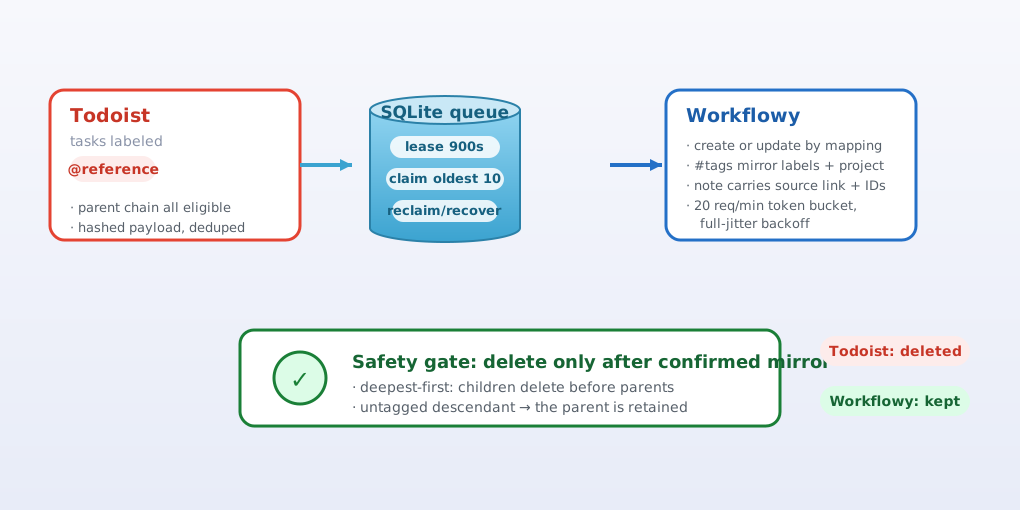
collect(hourly) fetches active Todoist tasks, filters to@reference, and enqueues each into a SQLite-backed queue. Eligibility is hereditary: a task qualifies only if its whole parent chain is eligible, and every payload is hashed (SHA-256 of the task, its project, and eligible ancestors) so unchanged tasks aren’t re-queued.work(every minute) claims the ten oldest ready jobs — under a 900-second lease — and processes them. The worker is where all the danger lives, and the design leans into it.
The worker’s loop is a state machine more than a script. For each job it re-fetches the live task: deleted on the Todoist side? Complete or cancel depending on whether a mirror already exists. Label removed? Cancel — and retain the mapping rather than deleting anything. Parent not yet mirrored? Defer a minute and wait. The transfer itself is idempotent — create or update by mapping, with the source link, IDs, labels, and metadata packed into the Workflowy note.
Only then, deletion — governed by three rules:
- Deepest first. Children are deleted before parents, so a parent’s delete implies its whole subtree is already settled.
- Confirmed mirror only. An ancestor isn’t eligible for deletion until every descendant’s mapping says
source_deleted— proven, not assumed. - One untagged descendant retains the parent. If any child isn’t marked
@reference, the parent survives with a “retained” status. Ambiguity never resolves to delete.
The infrastructure details
Because both Todoist and Workflowy rate-limit (the defaults: 20 requests/minute each), the clients sit behind token buckets, honor server Retry-After instructions, and back off with full-jitter exponential delays capped at an hour. Non-retryable errors park a job as blocked instead of thrashing. A worker that dies mid-lease simply loses the lease — expired claims are reclaimed on the next run, and a recover command releases anything still held, which matters when you’re stopping containers intentionally under Docker Compose.
What it taught me
The big lesson: deletion is the most underrated engineering problem. Copying data between two APIs is an afternoon; deleting the source safely is a distributed-systems exercise in confirmation ordering, partial failure, and crash recovery. Leases, deepest-first ordering, and retain-on-ambiguity aren’t enterprise ceremony — each one earned its place by answering “what if this dies right now?”
The second lesson is architectural: the collector only enqueues; the worker does the dangerous work. Keeping read-only ingestion separate from destructive processing made every safety rule easy to locate, and the queue made the whole thing restartable at will.
The source is on GitHub — the README covers setup, cron, and the Docker Compose deployment. My Todoist list is all signal now, and my references live where thinking happens.