The Crucible App: An Offline-First Operating System for 12-Week Cohorts
My coaching practice — discipline and integrity for ambitious men — kept hitting the same wall: the work happened in rooms I could only rent by the hour, and the practice lived in email threads and WhatsApp groups that forgot everything. A man sets a direction in week one and by week four nobody can see whether he’s still on it. Most men don’t lack effort — they lack a way to measure themselves honestly.
So I built the 3F App: the companion platform that runs the Crucible, my 12-week cohort format — season design, weekly calibration, accountable relationships, and Coach review in one place.
The Crucible
A Crucible is an organized 12-week cycle: a Review Week (current reality, unfinished commitments), a Refinement Week (clarify and make the plan realistic), then the 12-week season of execute-and-calibrate. Members join circles — small groups, buddy pairs, triads — with Coaches assigned to participants and Captains assigned to Coaches, and every conversation happens in explicit, membership-scoped channels.
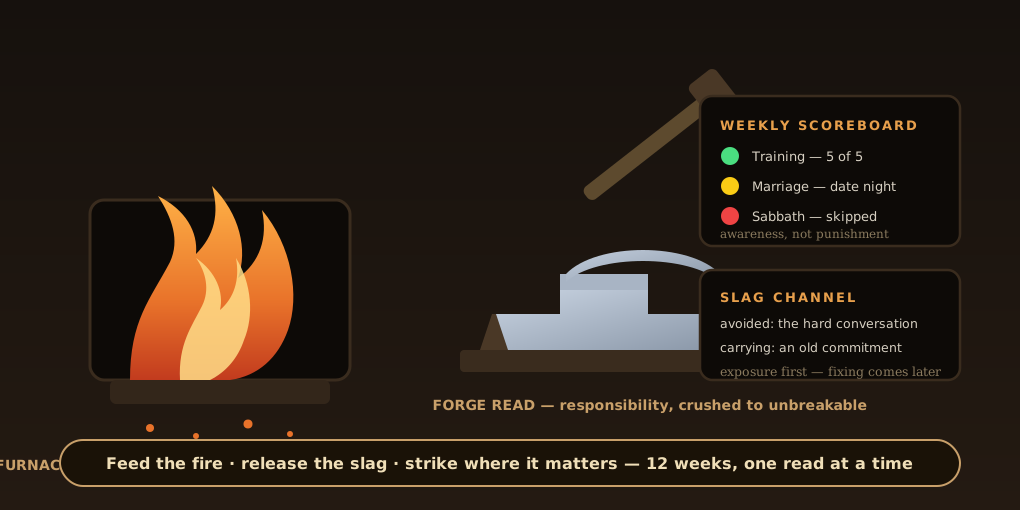
The backbone is the Season Plan: a stewardship plan, not a productivity plan. Ten steps — name the life domains that actually matter, define current reality in facts rather than shame, declare a 12-week outcome per domain, build protected containers (time, action, boundary, what gets removed), choose weekly actions, and — the step most men skip — name what must be eliminated. A season is not built on top of an overloaded life. It closes with a weekly scoreboard (Green/Yellow/Red — awareness, not punishment) and a named season describing the kind of man you’re becoming.
The 3F System Read: the weekly furnace
The weekly check-in is a structured calibration — six sections, mapped onto forge imagery:
- Aim — the Furnace Stack. What am I building toward, and a Momentum Scale read (Clogged → Clean-Burning, nine named levels) with required evidence: what specifically created that level this week?
- Meaning — the Hearth. The one moment that carried weight (or an honest record of numbness when nothing did).
- Values — the Refractory Lining. Values ranked as actually lived that week, not aspired to.
- Responsibility — the Anvil. A Forge Read (Crushed → Unbreakable) per role — man, father, builder, leader — with the evidence demanded: no stories. Just weight and truth.
- Friction — the Slag Channel. What I avoided, what drained me, what I’m still carrying. Exposure first; fixing comes later.
- Cultivation — the Hammer. One role to strengthen, and up to three strikes for next week — no fourth strike — pre-populated into next week’s read.
The operating method underneath: read your system, tell the truth, strike where it matters.
The engineering
The build reflects the same seriousness as the material:
- Offline-first PWA. Weekly reads happen in trucks and on job sites, so the React/TypeScript app works with no connection: encrypted local storage, a durable outbox (client-generated IDs, expected stream versions, retries, idempotency), conflict preservation instead of silent overwrite, and an Outbox screen showing every queued command’s state.
- Event-sourced core. FastAPI backend where the source of truth is append-only event streams —
SeasonPlanSubmitted,MomentumAssessed,FrictionExposed,DeliberateStrikeCommitted,WeeklyCalibrationReviewed— with read models as asynchronous projections and optimistic concurrency on writes. - Submissions are immutable unless a Coach reopens them — review history is preserved, revision is an explicit separate workflow.
- Versioned templates. Every submission snapshots the exact prompts and scale definitions used, so a Coach reviewing week 9 always sees the questions the participant actually answered.
- Relationship-based privacy. Roles never grant access — only explicit relationships and channel membership do. Coaches can’t rewrite plans, only request revisions; Captains see Coach status, never participant content.
- A non-generative assistant. The AI boundary is deliberate: it ranks published glossary terms and composes answers verbatim with citations — declining and escalating to the assigned Coach rather than inventing guidance.
What it taught me
The deepest one: honesty needs infrastructure. “Tell the truth about your week” is a nice poster; a required evidence field after every scale read is a system. The app’s design choices all flow from taking the coaching seriously — immutable submissions because revisionism is real, relationship-scoped privacy because a man’s disclosure belongs to the relationship he chose, no streaks or leaderboards because this is calibration, not performance.
The second lesson is operational: the whole platform is built through an autonomous Ralph loop with the backlog as the contract — shipping fast, adjusting quickly, exactly as the product principles demand. The first Crucible to run fully in-app is the laboratory, and the app improves the way it asks its members to: one honest read at a time.