A Fire Drill for Judgment: Tabletop RPG Mechanics for Team Decision Practice
Teams in enterprise technology are leaning harder on LLMs and reasoning tools every quarter, and I wanted to keep the muscle that atrophies when that happens: the ability to assess a situation, come up with a strategy, implement, and follow through — without reaching for technology. So I built a platform for running scenario simulations for the team I manage, borrowing the mechanisms of tabletop RPGs like Dungeons & Dragons and applying them to scenarios at work. Think of it as a fire drill, but through the conceptual approach: no fire, no pager, just practiced judgment.
The translation layer
Tabletop RPGs solved this problem decades ago — how do you get a group of people to collaboratively assess, decide, and act under constraints while having fun? — so I stole the mechanisms and translated them into plain words so non-gamers can join quickly:
- The Experience Driver runs the session (the Game Master, without the name).
- Roles give each person a clear job, with stated strengths and limits.
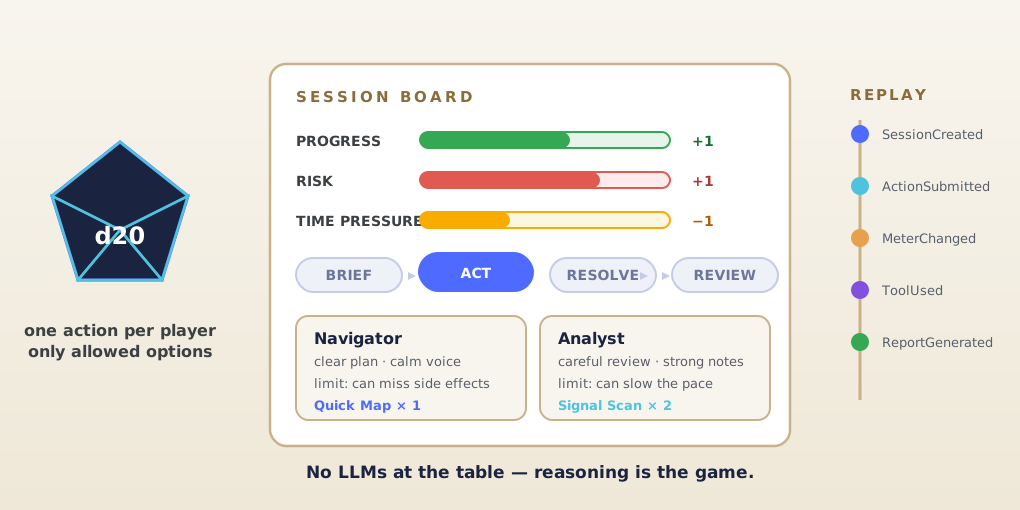
- Tools show what a role can do — each with limited uses. The Navigator’s Quick Map works once; the Analyst’s Signal Scan twice. Resource scarcity forces real choices.
- Rounds keep the team moving together through phases: brief → act → resolve → review.
- Replay lets managers and teams look back at every key choice afterward.
As the operator, I set up the experience: a scenario template defines the meters (progress, risk, time-pressure), action options with their meter impacts, role slots, per-round allowed actions, and debrief prompts. The team plays through. The platform enforces the rules — one action per participant per round, only options allowed that round, tools that actually run out — so the fire drill can’t be gamed.
The engineering
It’s a TypeScript monorepo with deliberate architecture, because a session log is the one thing a good debrief depends on:
- Onion architecture per module —
identity-access,character-library,scenario-catalog,live-session, andreplay-reportingeach keep domain logic at the center. - Event-sourced
live-session. The entire session is an append-only stream of a dozen event types —SessionCreated,RoleAssigned,RoundPhaseAdvanced,ActionSubmitted,MeterChanged(with a reason attached to every delta),ConditionChanged(RPG-style status effects),ToolUsed,ReportGenerated. The event stream is the replay truth, which makes after-action review a projection rather than a reconstruction. - CQRS + outbox worker. Writes flow through the
SessionAggregate; the worker drains an outbox and rebuilds read models for the dashboard, session board, and replay timeline. - The stack: Next.js web app, Fastify + tRPC API, Drizzle schema for PostgreSQL, Vitest tests over the aggregate rules, and an in-memory runtime so the whole platform can be explored and tested locally before a database exists.
The demo seed shows the intent end to end: a Navigator (keeps the team pointed at the goal, can miss side effects) and an Analyst (spots patterns, can slow the pace) playing “Lost Shipment Check-In,” where Check the facts lowers risk while Make a clear call buys progress at the cost of time pressure.
One honest note the README carries too: this was implemented and tested against the aggregate rules, but not yet executed on a live session — the next milestone is seating a real team.
What it taught me
The RPG frame works because it externalizes decision-making into shared artifacts. Meters make trade-offs visible; limited-use tools make prioritization physical; rounds make pacing collective; the replay makes reasoning inspectable. And precisely because no LLM is allowed at the table, the participants get reps at exactly the skill the tools are quietly absorbing — framing an ambiguous situation and owning a call.
It’s also the same methodology I keep circling back to: take known IP, package it sequentially, and let the system enforce the discipline. D&D figured out collaborative judgment under pressure long before I needed to teach it. I just moved it into a repo.