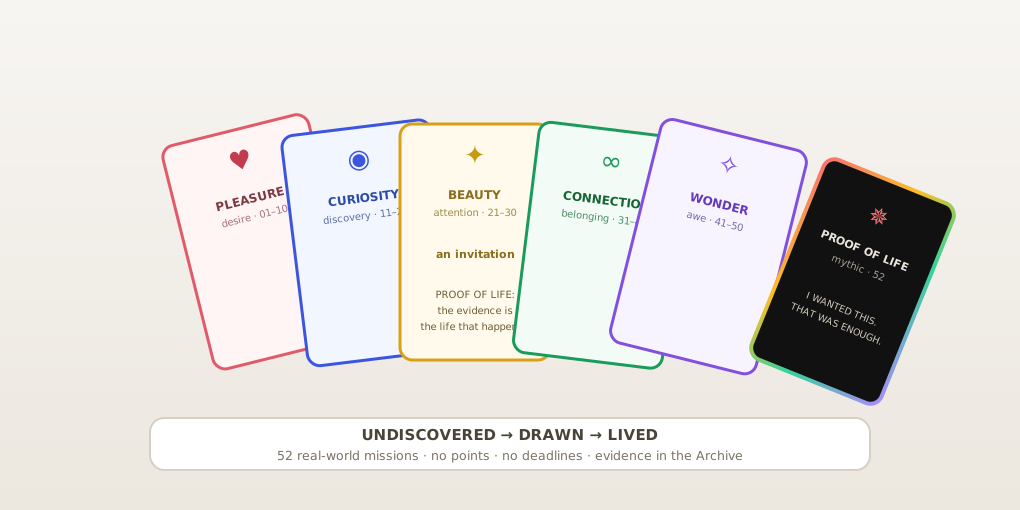
Proof of Life: A Collectible Game of Real-World Invitations
Some experiments are about software. This one is about the thing the software is for. Proof of Life is a collectible game of invitations: 52 real-world missions rendered as fantasy-style cards, where the point isn’t getting through the deck fastest — there’s no deadline, no points, no leaderboard. You draw an invitation, you go live it, you deposit the evidence in your Archive. When you’re done, you’re holding 52 pieces of evidence that you were here (source on GitHub).
The philosophy on the box: pleasure, curiosity, beauty, connection, and wonder don’t have to defend their place on the calendar with productivity. Their evidence isn’t what they produced — their evidence is the life that happened while pursuing them.
The deck
Five territories — five schools of magic — plus two prismatic Wild Cards:
- Pleasure (crimson, desire, cards 01–10), Curiosity (cobalt, discovery, 11–20), Beauty (gold, attention, 21–30), Connection (emerald, belonging, 31–40), Wonder (violet, awe, 41–50).
- The Wilds sit above all: 51 Follow the Thread (Legendary — wander without a plan; its ability, Serendipity, declares the question “what is the point of this?” has no power during the invitation) and 52 Proof of Life (Mythic — choose something you want even if nobody ever hears about it, do it, and keep an ordinary reminder inscribed “I WANTED THIS. THAT WAS ENOUGH.”).
Every card carries a full anatomy: name, territory, type line, rarity, artwork, quest, Proof of Life requirement, a special stretch, and flavor text that captions the art. Card states are the whole game loop: UNDISCOVERED → DRAWN → LIVED.
The technology
TypeScript + Vite with vanilla DOM (no framework), vitest, no backend, no accounts — draws and Lived evidence (including optional photos) persist in versioned localStorage. The deck data is typed in src/data/ and held to contract by schema tests: exactly 52 cards, unique, complete anatomy, canon text frozen.
The most interesting pipeline is the art. Each card’s artwork is a 4:3 watercolor painted from its art direction in the territory’s tonal range, starring one recurring heroine — the Wayfarer. The canon (figure bible, palettes, prompt recipe, generation standard) lives in specs/art/ART-DIRECTION.md, and generation runs offline through OpenRouter as base64 PNGs, committed per card and lazily attached when a card flips into view. The generation loop is the same Ralph-style discipline as the build: npm run art:loop produces one reviewed image per iteration — the canon keeps the 52 cards coherent, and review keeps the quality honest.
The whole repo is built with the Ralph harness too: ralph.sh for build loops, ralph-plan.sh for planning loops, fix_plan.md as the living backlog, typecheck + tests as back pressure.
What it taught me
The design constraint that shaped everything: the game must not gamify the wrong thing. No streaks, no optimization — card 52 explicitly “cannot be completed for points.” Building that meant the persistence model stores evidence, not scores, and the schema tests enforce the canon rather than a leaderboard. The other lesson is generative art with a spine: a written canon (palettes, figure bible, prompt recipe) is what lets 52 separately generated watercolors feel like one deck — constraints are the style.
Play it here: superdave2u.github.io/proof — draw an invitation, and come back with your proof.